


Read the published article here
JCPA head seeks to reset coalition building post-Oct. 7, Gaza war
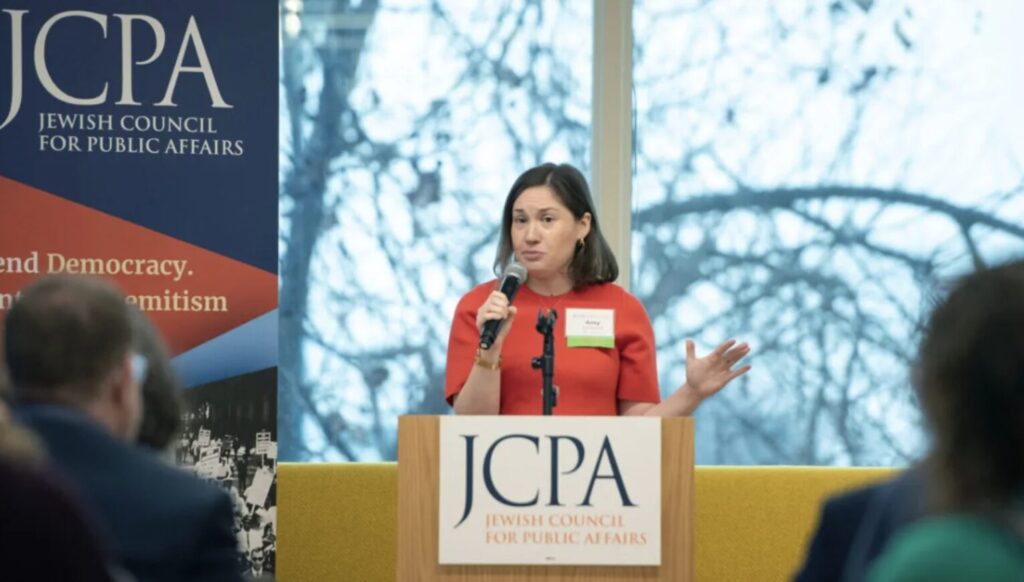
Amy Spitalnick, CEO of the Jewish Council for Public Affairs, speaks Feb. 18 at its West Coast summit in San Francisco. (Aaron Levy-Wolins/J. Staff)
When Amy Spitalnick became CEO of the Jewish Council for Public Affairs in summer 2023, she had big plans for rebuilding coalitions at a national level. After Oct. 7, Spitalnick realized she had her work cut out for her in a completely different way.
Today, Spitalnick feels that she stepped into her role at JCPA, a national group with a nonpartisan but liberal bent, at just the right moment.
“The vision for the new JCPA actually became even more relevant after Oct. 7,” she told J. “Because our work is to, among other things, be in coalition, progressive, civil rights, democracy spaces and help advance understanding that Jewish safety is inextricable from democracy.”
On Feb. 18, the JCPA hosted its inaugural West Coast summit in San Francisco to bring Jewish organizations together to assess the impact of the Israel-Hamas war, the broader Israeli-Palestinian conflict and the spike in antisemitism since Oct. 7.
The day featured discussions on California-specific topics and national issues, including how to break through “binary thinking” that can drive people to political absolutes, how Jewish nonprofits can assist people in response to the federal government’s immigration crackdown and how to respond to the Trump administration’s nearly $200 billion in cuts to SNAP, the federal food-assistance program.
Representatives from the Jewish Community Relations Council Bay Area, the Jewish Public Affairs Committee of California and Jewish Family and Community Services East Bay led discussions throughout the day.
JCPA’s efforts in coalition building go back to the Civil Rights Movement when it worked with the NAACP to lobby Congress to pass the Civil Rights Acts of 1957, 1960 and 1964. Today, its outreach extends to groups such as the Muslim Public Affairs Council.
Formerly financially tied to the Jewish Federations of North America, the JCPA decoupled from the federation movement in 2022 in part to increase its political independence.
Spitalnick sat down with J. the day before the summit to talk about how California and the Bay Area in particular have shaped the JCPA’s work nationwide.
This conversation has been edited for length and clarity.
How does California stand out to you in the national discourse around antisemitism and the best ways to counter it?
The San Francisco Bay Area specifically has seen some of the most visceral, polarized reactions post-Oct. 7 that have led to real harm in communities. But now we have an opportunity –– with this sort of tenuous, quasi-ceasefire that we have [between Israel and Hamas] and the fact that all of the hostages are finally home –– to do some resetting when it comes to coalitions and bridge building, and to learn what has worked and what hasn’t over the last few years. So that if, God forbid, another crisis happens, we can be better prepared and make sure that we’re able to build the sort of allyship and solidarity that our community needs, just as we can do so for others.
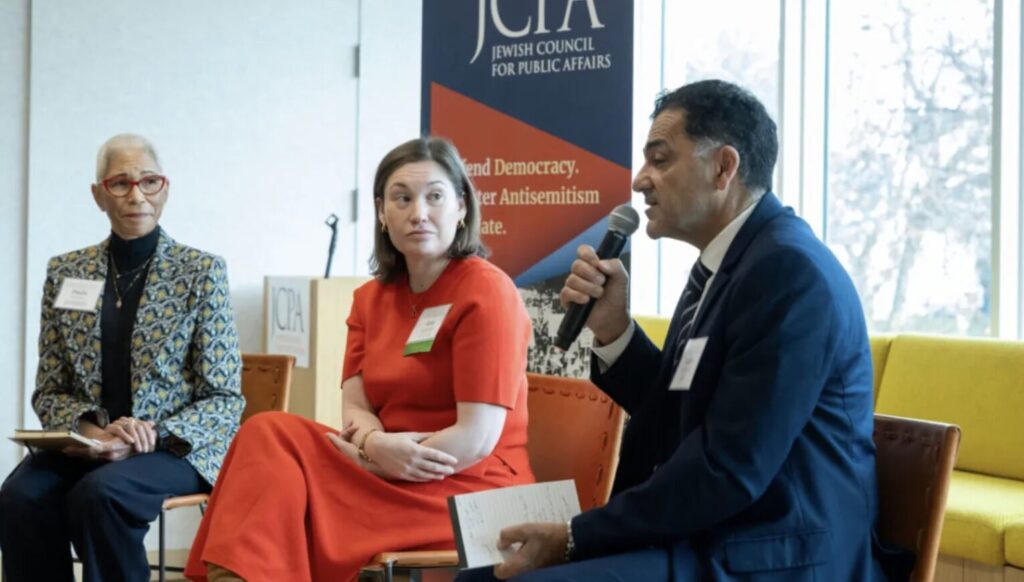
From left, Harry and Jeanette Weinberg Foundation chair Paula Pretlow and CEO of the Jewish Council for Public Affairs Amy Spitalnick listen to Muslim Public Affairs Council President Salam Al-Marayati at the summit. (Aaron Levy-Wolins/J. Staff)
The opening plenary at the West Coast summit featured you in conversation with Muslim Public Affairs Council (MPAC) President Salam Al-Marayati. What has been the extent of the JCPA’s work with MPAC?
They put out [statements] after the firebombing of Pennsylvania Gov. Josh Shapiro’s home, the Boulder attack and the Bondi Beach attack. We’ve also done joint work with them on a variety of issues, such as for funding hate-crime prevention grants.
After the shooting at the Capital Jewish Museum [in D.C], there were all these campaigns on social media that suggested killing Israeli Embassy staff members outside a Jewish event somehow wasn’t antisemitism and that killing people who were supporting the hostages somehow wasn’t antisemitism. So having the statement from 65 civil rights groups, including MPAC and other Muslim and Arab American groups, was so important because we were making clear that this is not up for debate.
For me, they’re a perfect representation of what it means to be in coalition and partnership with an organization with whom you have real policy disagreements on certain points. And we never lose sight of each other’s humanity, of each other’s right to safety, and of the fact that ultimately, our safety is interlinked, and they have shown up in solidarity with us in the Jewish community over and over again.
On the other hand, the American-Arab Anti-Discrimination Committee legally challenged AB 715, California’s new law to combat antisemitism in K-12 schools. What are your thoughts on the lawsuit and how does it factor into the national conversation?
There are these debates happening around the country about how we actually legislate “anti-antisemitism.” What AB 715 sought to do was actually address very specific, practical needs in the school system that the community had identified. And in its final version, the parallel bill also appointed coordinators for a variety of other communities that are facing their own very real threats and bigotry. It modeled what it looks like to do this in a way that hopefully brings a number of communities together.
Of course, there will always be those people who don’t think that there should be any antisemitism legislation, and that’s not a realistic position when we are facing record levels of antisemitism in this country. We need to make sure schools, other public officials, and law enforcement have real tools to keep Jewish and all communities safe, and we can do so in a way that doesn’t infringe on core civil liberties and rights and other protections.
Trying to muddy the waters by suggesting it’s impossible to do both is deeply dangerous. The Trump administration and others on the right have suggested [and supported the position] that there’s no way to counter antisemitism without undermining academic freedom. And then you have the far left suggesting that either antisemitism isn’t a real threat, or that we can’t be proudly Jewish or have some sort of relationship with Israel and have that be compatible with humanitarian or democratic values. We’re being offered these false choices on both extremes, when the reality is most people are actually living in that complex middle.
JCPA has also been very outspoken against the Trump administration adding new conditions to the federal nonprofit security grant program that would require recipients to cooperate in multiple ways with U.S. Immigration and Customs Enforcement. Given that the current status of the grant program is still ambiguous, do you think Jewish organizations should be looking for other funding sources?
Our guidance since this started over the summer has been to apply. You don’t accept the terms and conditions when you apply, only if you accept the funds. We’re now getting closer to a moment when organizations might need to actually accept the funds, and we’re going to have to grapple with what it potentially means to have these terms and conditions still not clarified, and talk to legal counsel.
There’s clearly increased concern coming from bipartisan voices [in Congress] at this point that organizations need clarity. We shouldn’t be forcing institutions to choose between their religious values and their security. They shouldn’t have to think about where to go fundraise for security cameras when this program exists to provide just that. We’re going to continue to advocate on this, and I’ve been really heartened to see more voices coming out and ringing the alarm bell on this.